TKI-LSH SME Call 2025 · Health Holland
PRECIS-BC
Precision Oncology Assessment of Treatment Response in Bladder Cancer
A two-phase prospective study (2026 to 2028) developing a urine test that helps doctors decide whether bladder cancer patients still need surgery, or whether their bladder can be preserved.
Project Overview
Every year, more than 150,000 people are diagnosed with muscle-invasive bladder cancer (MIBC). The standard treatment combines chemotherapy with the surgical removal of the bladder. But about 1 in 3 patients no longer have any tumour left after chemotherapy, meaning their bladder could in principle be saved.
The problem: today's CT and MRI scans cannot reliably tell who those patients are. So everyone gets the full surgery, "just to be safe". This is life-changing, and for many patients it is no longer necessary.
PRECIS-BC tests a simple idea: tumour DNA leaks into urine. By analysing that DNA with Hologenomix's HFX platform, and comparing it to the patient's own tumour profile, we want to show that a urine sample can identify the patients with a tumor-free bladder, who could safely keep it.
Project at a Glance
24 months, March 2026 to February 2028
Health Holland TKI-LSH SME Call 2025
Two prospective studies: Phase 1 assay optimisation, Phase 2 clinical validation
Phase 1: 10 to 20 cystoscopy patients. Phase 2: 60 MIBC patients (cT2 to T4a, N0M0) at Radboudumc
Urine cfDNA extraction (HFX) with whole exome sequencing and multi-omics characterisation
Identifying the ~30% of patients who could safely avoid radical cystectomy
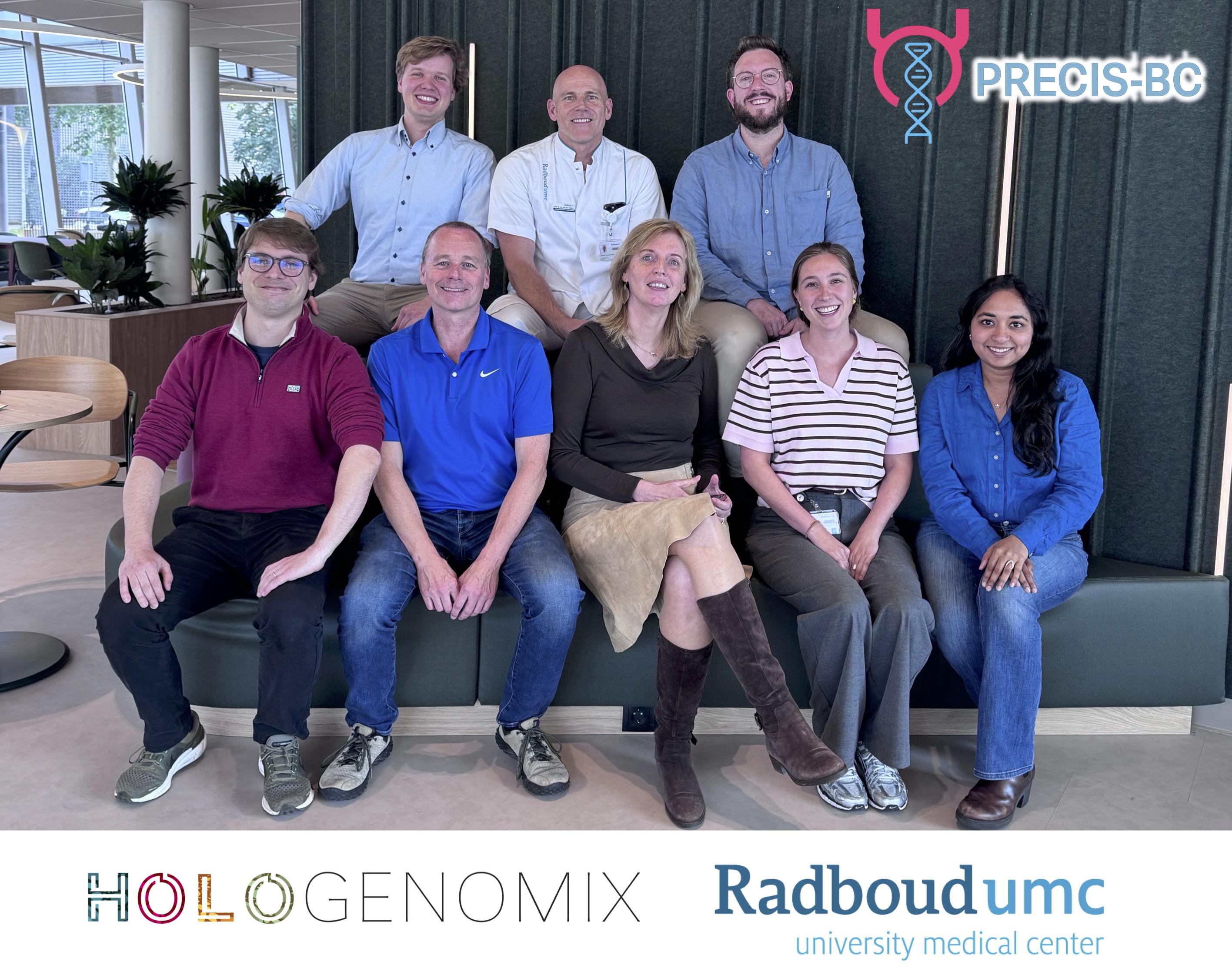
Consortium
Industrial innovation paired with clinical expertise.

Bioinformatics pipeline, urine cfDNA extraction and quantification, fragmentomics, methylomics, and long-read sequencing on the HFX platform.
Contact: David Calderón Franco, PhD · Director

Patient identification and consent, TURBT and cystoscopy specimen collection, urine and blood sample collection, pathological staging, and regulatory compliance.
Coordinating Investigator: Prof. dr. A.G. van der Heijden, MD PhD
Funded by
Health Holland · TKI-LSH SME Call 2025

Objective & Primary Endpoint
Objective
Validate the HFX urine cfDNA platform for assessment of local treatment response in MIBC, enabling evidence-based decisions between bladder preservation by surveillance and radical cystectomy. Phase 1 optimises the assay strategy (qPCR, methylation chip, WGS or WES). Phase 2 correlates tumour-tissue profiles with matched pre-cystectomy urine cfDNA in 60 MIBC patients.
Primary Endpoint (Phase 2)
The cfDNA detection rate in pre-cystectomy urine and its correlation with pathological complete response (pT0) confirmed by post-cystectomy histopathology (expected ~30%). Patients with residual disease (≥pT1) are expected to retain detectable tumour-specific signatures, while pT0 patients are expected to show molecular clearance, enabling identification of candidates for bladder preservation.
Work Packages
Three interconnected work packages bridging clinic, lab, and analysis.
Multi-omic Personalised Tumour Profile
Integrates tumour DNA (WP1) and urine cfDNA (WP2) into a per-patient signature, then tests whether molecular clearance predicts pathological complete response.
- Correlation of tumour DNA with urine cfDNA
- Multi-omics integration
- Histological confirmation as the metric for bladder preservation
Patient Recruitment & Tumour Profiling
Build the clinical pipeline and define each patient's tumour signature from TURBT tissue.
- Patient recruitment (N = 60) and informed consent
- Tumour tissue and urine collection
- Sample storage and transport
- DNA isolation and tumour DNA sequencing
- Personalised patient profile
Urine cfDNA Processing & Analysis
Extract and characterise cfDNA from pre-cystectomy urine on the HFX platform.
- cfDNA isolation from urine (HFX platform)
- Biological variability assessment
- cfDNA sequencing (long-read)
- cfDNA multi-omics profiling
Scientific Innovation
Why a urine-first liquid biopsy can change MIBC treatment decisions
Urine-first liquid biopsy
Urine cfDNA reflects local bladder tumour presence, unlike serum cfDNA, which can stay elevated even when the bladder tumour is cleared.
Multi-omics integration
Combines fragmentomics, methylomics and targeted mutation analysis for a comprehensive molecular picture beyond single-marker detection.
High-volume processing
Engineered for 75 to 150 mL urine inputs, overcoming the low cfDNA yields that limit conventional approaches.
Long-read sequencing
Oxford Nanopore reads preserve native methylation without bisulfite conversion, enabling joint genomic and epigenomic profiling.
Patient-specific signatures
Tumour-derived "molecular barcodes" enable highly sensitive and specific monitoring of treatment response.
Clinical translation path
Validated within existing Radboudumc clinical workflows, advancing from TRL 4 to 5 toward TRL 6 to 7 in future studies.
Questions about PRECIS-BC?
Reach out to learn more about this project or explore collaboration opportunities.